
3D van loading software

What Is The Party Rental Network?
A connected booking, website and AI-powered business platform built around party rentals and event hire, with tools for your equipment, customers, team and wider industry network.
What Type of Party Rental Business Do You Run?
Equipment records, safety documents, delivery planning and artwork tools help keep inflatable hire jobs organised.
The awkward part of loading a hire van is often not the last item squeezed inside. It is the first item needed outside. A blower buried behind furniture can turn a straightforward delivery into an unnecessary unloading exercise. 3D van loading software gives that problem a visual planning context: consider how equipment occupies the vehicle before committing to a loading sequence.
Party Rental Network includes transport planning and 3D van loading within its connected UK hire platform. The practical question is whether the software suits your vehicles, equipment and delivery routine—not simply whether a model looks convincing.
See what's possible

Plan for the first doorstep, not just the empty van
Imagine a Saturday run with a garden inflatable, a hall booking and an evening collection. This is an illustrative scenario, but it exposes three different loading demands: fitting the outbound equipment, accessing each delivery and leaving a workable arrangement for returns.
A useful assessment of 3D van loading software should therefore start with a real route. Review the Route Planning & Loading feature alongside the loading view. Route order and physical access need to make sense together. A tightly packed vehicle is not necessarily a practical delivery vehicle if the second customer's equipment blocks the first customer's kit.
Measure equipment in its travelling condition
Catalogue dimensions rarely tell the whole transport story. An inflatable's operating footprint is not its rolled size, while folding tables, stacked chairs and boxed accessories each create different packing shapes. Record what actually goes into the van, including protective covers and transport containers.
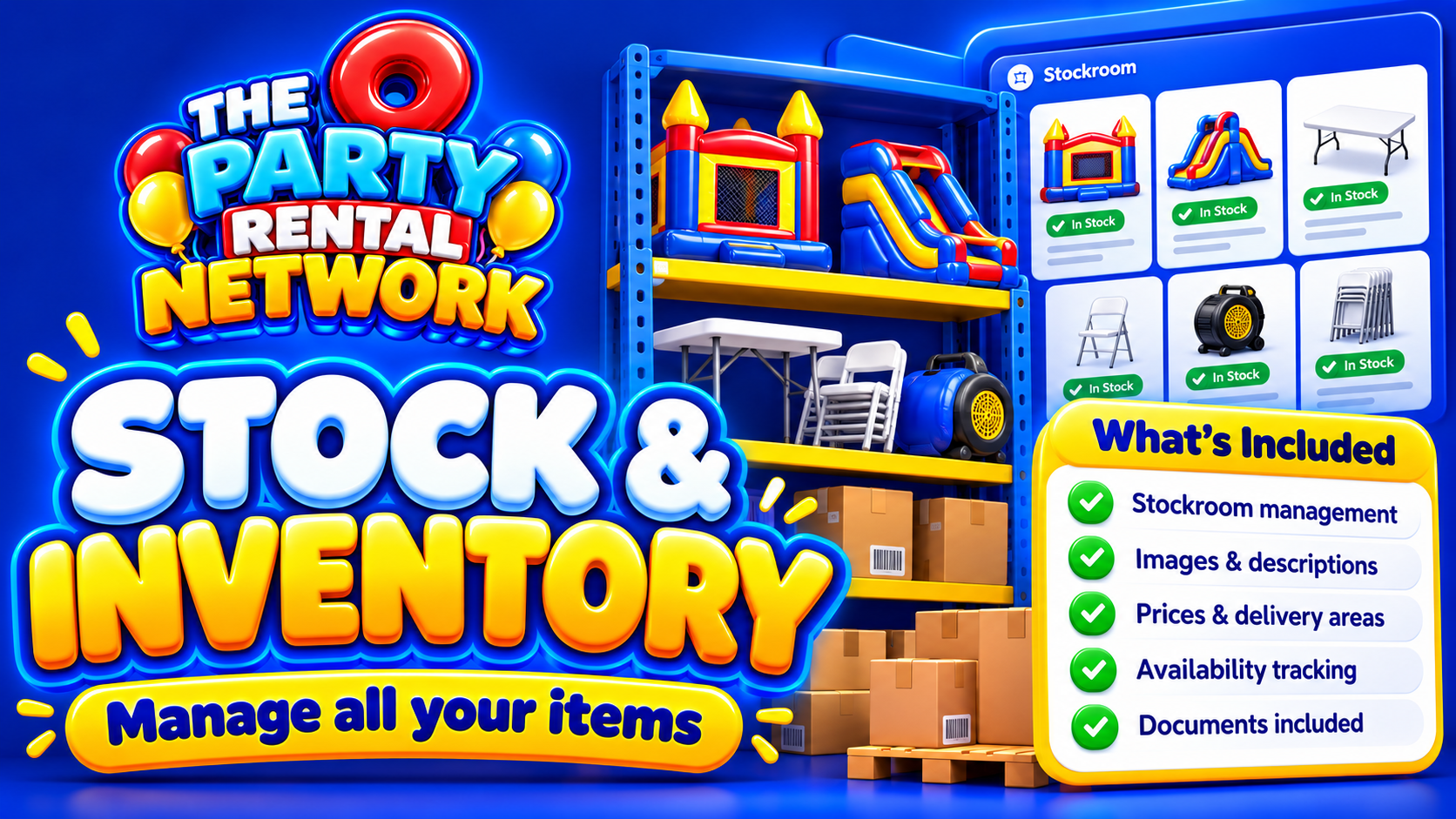
Use your Stock & Inventory records as the starting reference for identifying equipment, then check which dimensions and handling information the loading tool accepts. Do not assume every stock field automatically feeds a 3D model.
Measure the vehicle's usable interior too. Wheel arches, door openings and fixed storage can matter more than headline cargo volume. During setup, establish how the software represents these restrictions and what must remain a manual check. Consistent units and clear equipment names make plans easier to interpret.
Separate visual fit from payload and safe loading
A model can help explain where an item might sit. It cannot, by itself, establish that the vehicle is safe or legal to drive. Payload, axle limits, load restraint and manual handling remain separate responsibilities.
For example, a compact collection of heavy bases may occupy little floor space while presenting a very different transport problem from lightweight decorations. Assess weight as well as geometry, and verify whether any weight-related checks are supported rather than assuming they are included.
Allow for securing the load and reaching necessary equipment. Follow vehicle guidance and competent loading procedures; software does not replace qualified safety advice or certify equipment.
Choose software features, then build the working system
Software selection concerns the tool: what vehicle shapes it can represent, how equipment is entered and how clearly staff can understand a proposed load. A working loading system also includes your measurements, checking routine and responsibility for last-minute changes.
When assessing a package, ask how plans are created, amended and shared. Confirm whether saved vehicle layouts, reusable item dimensions or particular display controls are available; these should be demonstrated, not inferred from the term “3D”.
Booking changes are another practical test. Review Online Bookings in the context of your workflow, then establish how amended equipment requirements reach whoever prepares the load. Do not assume every change automatically rebuilds a plan.
Test a difficult hire day before choosing a package
Bring an awkward example to a demonstration: mixed furniture and inflatables, a narrow doorway, or a collection following several deliveries. Ask to see how you would assess fit and revise the arrangement when one item changes.
For operators exploring Bouncy castle booking software, include blowers, mats and accessories rather than testing only the main inflatable. Businesses considering the wider Party hire supplier network should use their own fleet and stock as the evaluation baseline.
You can book a demo to confirm package access and suitability. Value depends on usable functionality and manageable setup, not an unsupported promise of savings.
Questions about 3D van loading software
Is 3D van loading software free?
Free network accounts can list equipment and become eligible for opportunities. Paid subscriptions provide business tools according to package. Confirm which package includes the loading functionality you need before you join the network; opportunities are not guaranteed bookings.
Does a 3D plan guarantee everything will fit?
No. Its usefulness depends on accurate measurements and how the software represents objects and vehicle restrictions. Real equipment can have irregular shapes, so check clearances, handling space and the physical load before departure.
Can it account for delivery order?
Delivery order should be part of your assessment. Ask how the available loading workflow supports access at successive stops, and test whether the proposed arrangement lets staff reach each customer's equipment without unnecessary handling.
Is this live vehicle tracking?
No such assumption should be made. Route and driver planning concern intended journeys and assignments. Live vehicle tracking is a separate capability; a route plan or 3D loading view does not establish that tracking is available.
What should I prepare for setup?
Gather usable vehicle measurements, packed equipment dimensions and a representative delivery schedule. Identify awkward shapes and items that need special handling. Then confirm supported inputs and decide who keeps the underlying information current.
Can loading software replace experienced judgement?
No. It supports planning, while staff still need to check the actual vehicle, equipment condition, restraint and safe handling. Treat the visual plan as a preparation aid, not permission to ignore physical or legal limits.