
Bouncy Castle Hire Business Profit Calculator


Operating a bouncy castle hire enterprise in the United Kingdom requires far more than purchasing inflatables and setting them up on weekend mornings. Many business owners mistake gross booking revenue for net earnings, only to discover at the end of the trading year that vehicle maintenance, storage fees, safety certifications, and insurance have significantly eroded their margins. A dedicated approach to calculating true unit profitability allows operators to determine whether each delivery route, equipment type, and seasonal package generates genuine value or merely exhausts resources.
Understanding the mechanics of a bouncy castle hire business profit calculator gives you the financial clarity needed to scale sustainably. By factoring in both obvious operational expenditures and easily overlooked indirect costs, you can make informed decisions about hiring rates, asset purchases, and regional delivery boundaries. Achieving financial stability in this competitive industry demands rigorous accounting and streamlined operational workflows that protect your bottom line throughout every month of the year.
See what's possible

Business Benefits
Applying a structured profit calculation methodology provides complete visibility over which inflatables deliver the highest return on capital invested. Operators frequently discover that smaller, low-maintenance children's inflatables yield superior margins compared to complex assault courses that require substantial handling labour, oversized transport, and extended setup schedules. When you comprehend the exact net margin per booking, you can prune underperforming assets from your fleet, reprice complex setups to reflect their genuine workload, and concentrate marketing efforts on the most lucrative event segments.
Accurate margin calculation also safeguards your cash flow against the seasonal realities of the British climate. Summer weekends often create substantial cash inflows, but without an objective financial formula, winter storage overheads, staff retention, and scheduled compliance renewals can produce acute financial pressure. Knowing your operational breakeven threshold enables you to determine competitive off-peak pricing, construct viable indoor hire packages, and set aside realistic capital reserves for regular equipment maintenance without putting day-to-day operations at risk.
How Party Rental Network Helps
Party Rental Network equips commercial hire operators with sophisticated infrastructure designed to simplify financial governance and operational efficiency. The integrated bouncy castle booking software unifies your customer pipeline, booking diary, and revenue streams, eliminating double bookings while generating precise booking data needed for profitability analysis. With our automated payments and accounts suite, transaction fees, deposits, and outstanding balances are tracked in real time, giving you instantaneous access to true gross and net figures across all equipment categories.
Beyond basic administrative management, the platform directly reduces the variable costs that eat away at hire profits. Intelligent route planning and van loading tools organise delivery schedules to minimise mileage, fuel consumption, and vehicle wear, transforming potentially unprofitable outer-boundary hires into lucrative drop-offs. Combined with comprehensive customer management features and our proprietary AI assistant Yodo, the platform handles repetitive operational enquiries and administrative tasks, freeing you to focus on high-value commercial growth and operational safety.
Mapping Fixed Versus Variable Hire Costs
Calculating genuine profit requires a meticulous division between fixed overheads and variable job costs. Fixed costs continue regardless of whether an inflatable leaves the storage depot on a given weekend. These expenses typically include annual commercial storage rent, website hosting, advertising subscriptions, motor insurance, breakdown cover, and mandatory public liability insurance. Furthermore, British safety standards require inflatables to comply with BS EN 14960, necessitating annual testing via schemes such as PIPA alongside regular PAT testing for all electrical blowers and extension cables. These statutory and regulatory costs must be totalled annually and apportioned across your projected hire volume to determine your baseline operating cost.
Variable costs, conversely, scale directly with the number of hires delivered. Every additional booking incurs transport fuel expenses, staff wages for drivers and setup assistants, cleaning chemicals, generator fuel, and consumable replacement costs for items like ground anchor pegs, sandbags, and heavy-duty tarpaulins. Vehicle depreciation and tyre wear must also be calculated on a per-mile basis rather than treated as incidental expenses. Failing to allocate these variable costs accurately leads operators to accept distant hires that generate zero net profit once fuel, vehicle depreciation, and staff overtime are settled.
Working Through an Illustrative Unit Profit Model
To visualise how a profit calculator functions in practice, consider an illustrative scenario for a standard front-slide combination bouncy castle. Please note that these numbers are purely illustrative example figures, and you must verify your own supplier quotes, current fuel expenses, and regional wage rates. Assume an inflatable is hired out for an illustrative fee of £100 for a weekend party. If fuel for the round trip is estimated at £12, direct staff setup wages amount to £25, and cleaning materials along with wear allowances equal £3, the direct variable expenditure totals £40, leaving an initial gross margin of £60.
From that remaining £60, you must deduct the allocated fixed overheads for the hire. If your annual insurance, storage, marketing, and PIPA testing amortise to an illustrative £22 per booking based on your annual hire volume, the true pre-tax net profit on that hire sits at £38, rather than the initial headline revenue of £100. Over a standard operating season of forty hires for that individual unit, that net margin produces £1,520 in true operating surplus. Viewing your fleet through this unit-level lens reveals whether your current pricing structure comfortably covers overheads, yields sufficient profit, and amortises initial asset purchase costs within a sensible timeframe.
Maximising Fleet Yield and Operational Efficiency
Once baseline profitability is established, business owners can utilise strategic operational adjustments to increase net yield across every hire run. Increasing your average order value through add-on products is one of the most effective levers available. Introducing garden games, popcorn machines, or matching safety mats incurs negligible transport space and zero additional fuel costs, allowing the majority of the supplementary fee to convert straight into net profit. Structured packaging transforms standard single-unit hires into multi-product deliveries that substantially elevate your revenue per van run.
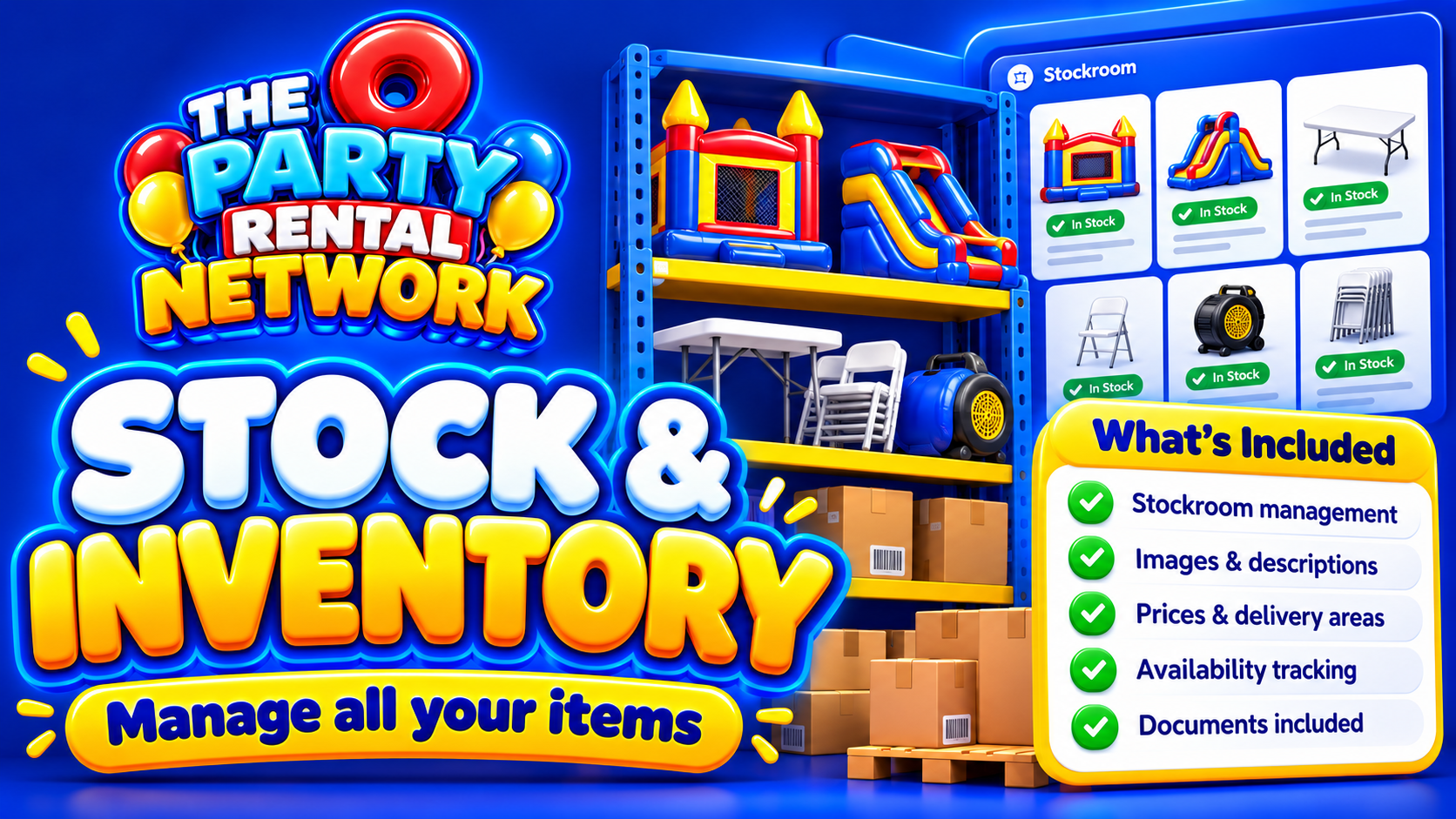
Fleet visibility is equally essential for optimising asset utilisation and preventing dead stock during peak summer periods. Using comprehensive stock inventory management enables you to identify slow-moving equipment and run targeted promotional campaigns to elevate hire frequency. When local demand exceeds your vehicle capacity on busy dates, the party rental booking exchange allows you to sub-hire vetted equipment or pass overflow leads to trusted operators within the wider network for a commission, monetising excess enquiries without incurring additional operational overheads.
Frequently Asked Questions
How do I calculate the breakeven point on a new bouncy castle purchase?
To establish your breakeven threshold, divide the total purchase price of the inflatable, blower, and anchor accessories by the projected net profit per hire after accounting for direct delivery, labour, and allocated fixed overheads. This calculation reveals the exact number of hire outings required before the unit has paid for itself and begins generating genuine commercial profit for your enterprise.
What annual compliance and testing costs must I factor into my calculations?
Operating legitimately in the UK requires accounting for annual physical inspections under BS EN 14960 standards, which often involves testing schemes such as PIPA, as well as regular PAT testing for all electrical accessories and blowers. You must also maintain robust commercial public liability insurance and appropriate motor vehicle policies, which should be checked directly with your insurer and inspection bodies to obtain precise annual figures for your calculator.
How does delivery distance affect my overall profit calculation?
Delivery distance influences more than simply fuel consumption; it also increases vehicle depreciation, tyre wear, and paid driver hours while restricting the total volume of drops a van can complete during morning setup windows. Establishing tight delivery zones with tiered surcharges ensures that distant hires remain profitable rather than eroding the margins generated by closer, more efficient bookings.
Why is gross turnover a misleading metric for bouncy castle operators?
Gross turnover reflects total customer payments but completely ignores the substantial outgoings required to deliver hire services, including seasonal storage, vehicle maintenance, staffing, and compliance renewals. Tracking turnover alone often creates a false sense of financial health, masking underlying inefficiencies, loss-making delivery runs, or underpriced commercial packages.
How does management software improve the accuracy of profit calculations?
Dedicated software captures real-time data across bookings, payments, and fuel routes, eliminating manual estimation and replacing guesswork with factual performance metrics. By scheduling a session to book a demo, you can explore how automated reporting reveals your most profitable assets, route efficiencies, and seasonal trends.
How should I account for weather-related cancellations in my financial projections?
Because the UK climate frequently brings seasonal rain and high winds that exceed safe operating thresholds under BS EN 14960, your annual profit model must incorporate a realistic cancellation buffer based on historic regional patterns. Establishing clear terms regarding indoor venue relocations or wet-weather booking credits helps stabilise baseline cash flow throughout unpredictable trading periods.
Helping Party Rental Businesses Across the UK
England: London | Birmingham | Manchester | Liverpool | Leeds | Sheffield | Bristol | Nottingham | Leicester | Coventry | Bradford | Newcastle upon Tyne | Southampton | Portsmouth | Plymouth | Derby | Wolverhampton | Stoke-on-Trent | Norwich | Oxford | Cambridge | York | Peterborough | Sunderland | Brighton and Hove | Milton Keynes | Preston | Hull | Gloucester | Exeter | Bath | Chester | Carlisle | Durham | Lancaster | Lincoln | Worcester | Hereford | Canterbury | Winchester | Chelmsford | Colchester | Southend-on-Sea | Salford | Wakefield | Doncaster | Westminster | St Albans | Salisbury | Chichester | Truro | Wells | Ripon | Ely | Lichfield
Wales: Cardiff | Swansea | Newport | Wrexham | Bangor | St Asaph | St Davids
Scotland: Glasgow | Edinburgh | Aberdeen | Dundee | Inverness | Stirling | Perth | Dunfermline
Northern Ireland: Belfast | Derry/Londonderry | Lisburn | Newry | Armagh | Bangor (County Down)